
What amortization actually means
Amortization is the process of paying off a debt with regular, equal payments over a fixed period. The word comes from the Latin mors — death. You are, quite literally, killing the debt off in instalments.
The important part is not that the payments are equal. It is that what each payment does changes every single month, even though the amount never does. That gap between a constant payment and a shifting purpose is where almost all financial confusion about loans lives.
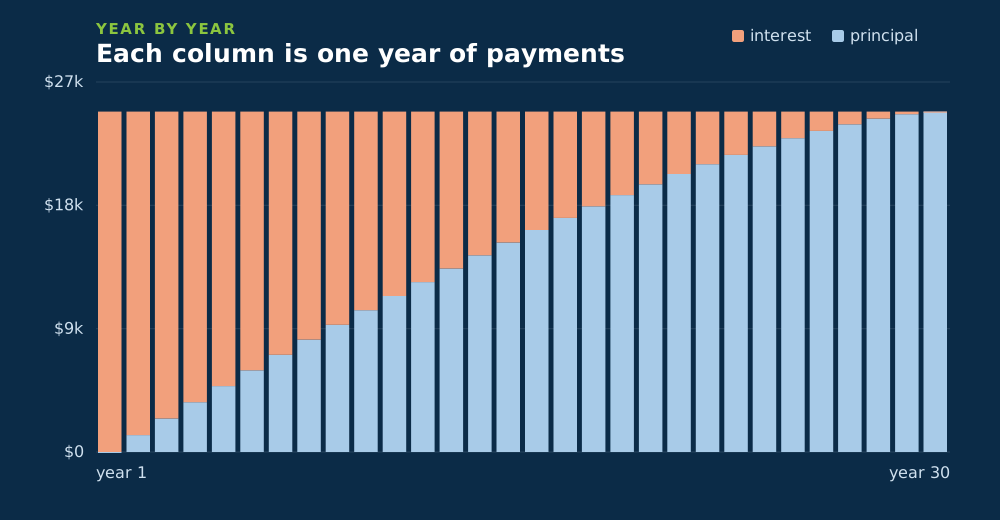
The split, and why it moves
Every payment is divided in two, in a strict order:
- Interest first. The lender charges you for the month based on what you currently owe.
- Principal gets the rest. Whatever is left over reduces the balance.
Take a $350,000 loan at 6.5% over 30 years. The payment is $2,212.24. In month one you owe the full $350,000, so the interest charge is $350,000 × (6.5% ÷ 12) = $1,895.83. That leaves $316.41 to reduce the balance. Roughly 86 cents of every dollar goes to the lender.
Next month you owe $349,683.59. Very slightly less, so the interest is very slightly lower, so slightly more goes to principal. Repeat 360 times.
The crossover point
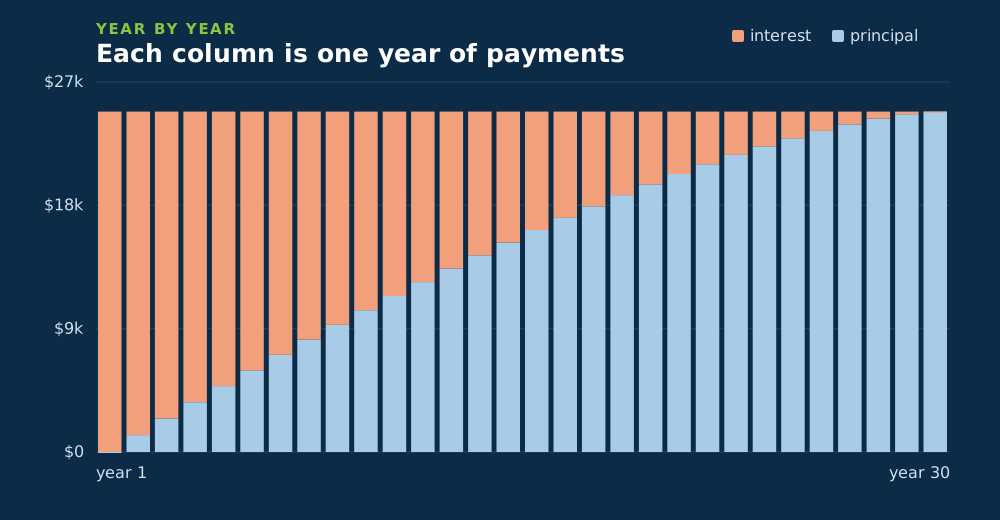
Because the shift is gradual, there is a specific month where the two halves finally trade places — where principal exceeds interest in a single payment for the first time. On that $350,000 loan it is payment 233, in year 20.
Read that again. For the first two-thirds of a thirty-year mortgage, the majority of every payment is rent on money rather than ownership of a house.
This is not a trick and nobody is hiding it. It falls directly out of charging interest on an outstanding balance. But it explains several things that otherwise look strange:
- Why your balance after five years of payments has barely moved.
- Why selling early feels like you got nothing for your payments.
- Why an extra payment early in a loan is worth several times the same payment late.
You can find the crossover on your own numbers with the amortization schedule calculator — it is marked directly on the chart.
The formula, if you want to check
The level payment comes from the annuity formula:
M = P × r ÷ (1 − (1 + r)−n)
P is the amount borrowed, r is the periodic interest rate — the annual rate divided by the number of payments a year — and n is the total number of payments. For a monthly loan at 6.5%, r is 0.065 ÷ 12 = 0.00541667.
Building the schedule from there is three lines repeated:
- Interest = balance × r
- Principal = payment − interest
- New balance = balance − principal
That is the entire mechanism. Every amortization table in the world, from a car loan to a commercial mortgage, is that loop.
Why extra payments compound
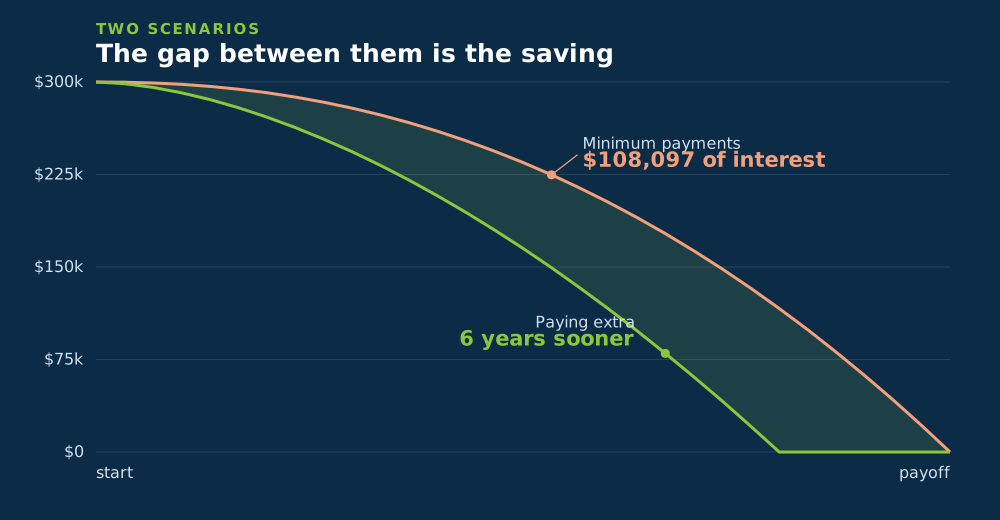
A scheduled payment gets split. An extra payment does not — every cent of it reduces the balance. And because next month's interest is calculated on that smaller balance, the saving repeats, and grows.
On the same $350,000 loan, adding $200 a month removes about six years and roughly $108,000 of interest. You will have paid in around $17,000 of extra payments to avoid $108,000 of interest.
The timing matters enormously. The same $200 a month started in year 15 saves a fraction of that, because there is far less remaining interest left to avoid.
Reading your own schedule
Three columns tell you almost everything:
The interest column
Add it up for the year. That is your true cost of borrowing for those twelve months, and on most mortgages it is the figure that appears on your annual statement.
The principal column
This is the only column that builds equity. Sum it over a period and you have exactly how much of the house you now own, ignoring price movement.
The balance column
What you would need to pay to walk away today, before any early-repayment charge. Compare it against your lender's redemption figure — they should agree to within a few dollars.
When your lender's numbers differ
A few dollars a month is normal and comes from two places: rounding, and the day-count convention written into your note. Loans variously accrue on a 30/360, actual/365 or actual/360 basis, and each produces a slightly different monthly interest charge.
A large gap is different, and almost always means something is in their figure that is not in yours:
- Escrow. Property tax and insurance collected alongside the loan payment.
- Mortgage insurance. PMI or MIP, which is not part of the loan at all.
- A financed fee. Origination costs rolled into the balance make the principal higher than the price you agreed.
- A different rate. Sometimes the quoted rate assumed discount points you did not buy.
Ask for a breakdown rather than assuming either figure is wrong.
Loans that do not amortize this way
Interest-only loans charge interest and nothing else for a set period. The balance does not move at all, and the payment jumps sharply when the interest-only window ends.
Balloon loans amortize on a long schedule but end early, leaving a large lump sum due. The monthly payment looks like a 30-year loan; the term is five or seven.
Credit cards are not amortizing at all. A minimum payment is a percentage of the balance, which falls as the balance falls, which is why paying the minimum can take decades.
Adjustable-rate mortgages amortize normally between resets, then recalculate. Any projection past the first reset is a guess, which is why this site models fixed rates only.