
Two things to establish first
Are your loans federal or private?
This determines everything else. Federal loans carry income-driven plans, deferment and forbearance rights, death and disability discharge, and access to forgiveness programmes. Private loans carry whatever the contract says, which is usually much less.
What rate is each loan at?
If you borrowed across several years you likely hold several different rates. That matters enormously for which loan to target with extra payments, and it is invisible if you only look at the total.
The plans, compared on cost
Standard — 10 years
Fixed payments over 120 months. The highest monthly payment and the lowest total cost. The default for a reason: if you can afford it, nothing else beats it on money.
Graduated
Starts lower and rises every two years, finishing in 10 years. Total cost is modestly higher than standard. Reasonable if your income is genuinely about to rise; a poor trade if it is not.
Extended — up to 25 years
Lower payments across a much longer term. This is the term-stretch problem from mortgages, transplanted: a smaller payment that can nearly double total interest.
Income-driven
Payments set as a share of discretionary income and recalculated annually, with any remaining balance forgiven after a set period. Genuinely valuable if your debt is large relative to income, or if you are pursuing Public Service Loan Forgiveness.
Two things people miss. First, on some plans the payment does not cover the accruing interest, so the balance grows while you pay. Second, forgiven balances may be treated as taxable income depending on the programme and the year — a large forgiveness can carry a large tax bill.
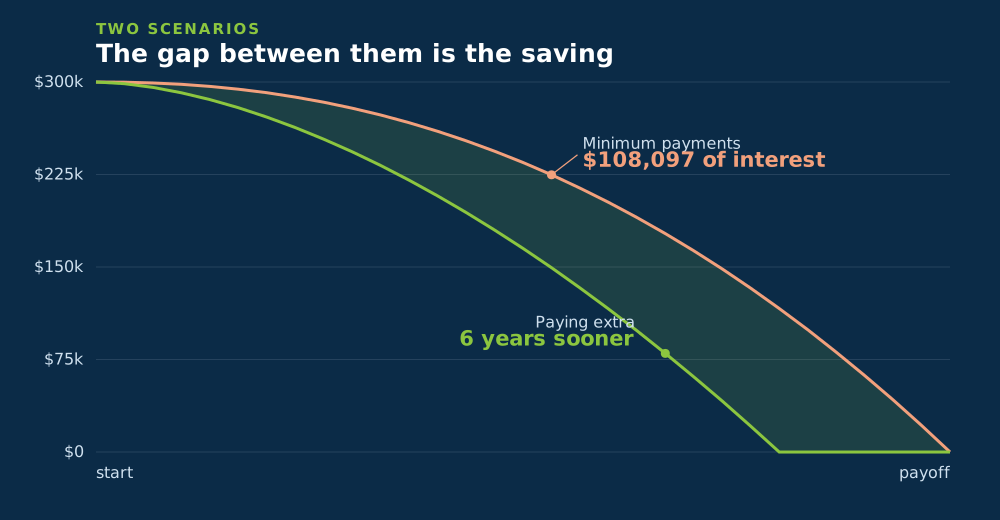
You can compare any two plans on total cost using the loan comparison calculator — enter each as a separate offer with its own term.
Capitalisation, the quiet one
Unpaid interest usually sits separately from the principal. At certain trigger events it is capitalised — added to the principal — and from then on you pay interest on that interest.
Common triggers: the end of a grace period, exiting deferment or forbearance, leaving an income-driven plan, or failing to recertify income on time.
The effect is not small. A borrower who spends three years in forbearance on $40,000 at 6% accrues about $7,200 of interest. Capitalised, the balance becomes $47,200 and every future interest charge is calculated on the larger figure.
Paying even the accruing interest during deferment prevents this entirely, and is the highest-value small action available to most borrowers.
Refinancing federal loans
Private refinancing can cut the rate meaningfully, particularly for borrowers with strong income and credit. It is also irreversible, and it surrenders every federal protection:
- Income-driven repayment
- Public Service Loan Forgiveness eligibility
- Federal deferment and forbearance
- Death and disability discharge
- Any future federal relief programme
A reasonable test: refinance federal loans only if your income is stable and comfortably covers the payment, you are not pursuing forgiveness, you have an emergency fund, and the rate saving is large enough to be worth losing an insurance policy you cannot buy back.
Private loans carry none of those protections to begin with, so refinancing them is a straightforward rate comparison.
Where extra payments should go
If you hold several loans, direct everything spare at the highest rate first while paying minimums on the rest. This is the avalanche method and it always costs least.
Two mechanical warnings specific to student loans:
- Servicers commonly spread extra payments across all loans by default. You must instruct them to apply it to one specific loan.
- Extra money is applied to fees, then accrued interest, then principal. If interest has accrued, part of your overpayment goes there first.
If you cannot pay
Do not simply stop. Federal default carries wage garnishment, tax refund seizure and severe credit damage, and it is far harder to unwind than to avoid.
In rough order of preference: switch to an income-driven plan, which can produce a very low or zero payment; request deferment, where interest may not accrue on subsidised loans; request forbearance, where interest always accrues; and for private loans, contact the servicer early — hardship programmes exist but are rarely advertised.