
Seller financing calculator
An owner-carried note is usually amortised over thirty years but due in five. The payment looks like a mortgage; the balloon is the part that decides whether the deal works.
Seller financing calculator
What seller financing actually is
The seller becomes the bank. You sign a promissory note secured by a mortgage or deed of trust, pay the seller monthly, and no institutional lender is involved. It exists because it solves problems for both sides: a buyer who cannot get conventional financing, and a seller who wants the interest income, a faster close, or instalment-sale tax treatment.
The balloon is the deal
Almost every owner-carried note amortises over 20 or 30 years but comes due in three to seven. That structure keeps the payment low while giving the seller their money back within a reasonable horizon.
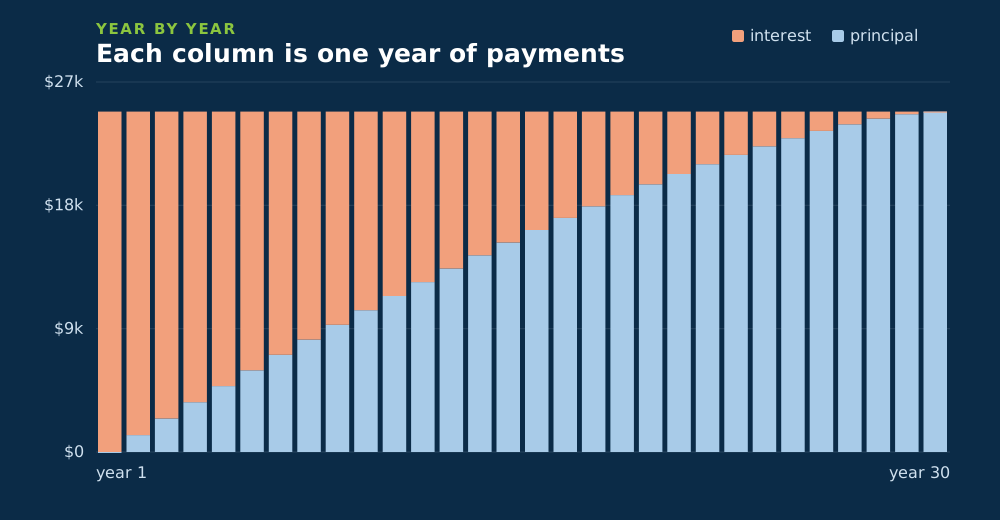
The consequence is unforgiving arithmetic. A 30-year amortisation repays almost no principal early — on a $256,500 note at 7%, five years of payments retire roughly $17,000, so the balloon is still around 94% of what you borrowed. You are not paying the loan down; you are renting the money and deferring the purchase.
That is fine if you have a plan. It is ruinous if the plan was "refinance later" and rates, appraisals or your credit have moved against you.
What to negotiate beyond the rate
- The balloon date. Seven years is far safer than three. It is often the cheapest concession for a seller to give.
- An extension option. The right to extend once, at a stated rate, for a stated fee.
- No prepayment penalty. You want the freedom to refinance the moment it makes sense.
- Substitution or partial release if the deal involves more than one parcel.
Two things to verify before signing
Is there an underlying mortgage? If the seller still owes a bank, almost every mortgage contains a due-on-sale clause that lets the lender call the loan on transfer. Wraparound structures exist and are used, and they carry that risk. Know it is there.
Who services the note? A third-party servicer handles collection, the amortisation record, escrow and the annual interest statement. It costs a small monthly fee and prevents the disputes that arise when two private parties keep their own version of the ledger.
Seller financing is a contract between individuals with no institutional guardrails. Have a real estate attorney in your state draft or review the note and security instrument.
Guides that explain this
Written with the same engine, so every figure agrees with the calculator.
 Amortization explained: where every payment actually goesA plain-English guide to amortization — why early payments are almost all interest, when the crossover happens, and how to read your own schedule with confidence.9 min read
 Compound interest works both waysHow compounding works, why frequency matters far less than people think, the rule of 72, and why the same force that grows savings traps card debt.9 min read
 How to pay off your mortgage earlySix ways to clear a mortgage early, what each actually saves in dollars and years, and the cases where overpaying is the wrong move.11 min read
Questions people actually ask
How does seller financing work?
The seller acts as the lender. You sign a promissory note secured by a mortgage or deed of trust and pay the seller directly, usually amortised over 20–30 years with a balloon payment due in three to seven.
What is a balloon payment in seller financing?
The remaining balance, due in full on a set date. Because a 30-year amortisation repays very little principal early, a five-year balloon on a $256,500 note at 7% is still around $239,000 — roughly 94% of the original amount.
Is seller financing legal if the seller still has a mortgage?
It happens, through wraparound structures, but nearly every mortgage has a due-on-sale clause allowing the lender to call the loan when the property transfers. Both parties should take legal advice before proceeding.
Who handles payments on an owner-carried note?
A third-party note servicer for a small monthly fee. They collect payments, maintain the amortisation record, manage escrow and issue the annual interest statement, which avoids disputes over the ledger.