
Simple versus compound
Simple interest is charged on the original amount only. $10,000 at 5% earns $500 a year, every year. After 30 years: $25,000.
Compound interest is charged on the original amount plus the interest already accumulated. Year one earns $500 on $10,000. Year two earns $525 on $10,500. After 30 years: $43,219.
Same rate, same deposit, $18,219 of difference, produced entirely by interest earning interest.
The formula is A = P(1 + r/n)nt — P is the starting amount, r the annual rate, n the compounding periods per year, t the years.
Frequency matters less than you think
$10,000 at 5% for 10 years:
- Annually: $16,289
- Monthly: $16,470
- Daily: $16,487
- Continuously: $16,487
The step from annual to monthly is worth about $180. From monthly to daily, $17. There is a mathematical ceiling — continuous compounding — and daily is already almost exactly there.
Which means marketing that emphasises "compounded daily" is selling you the last 0.1%. The rate and the time are what matter.
The rule of 72
Divide 72 by the interest rate and you get roughly the years to double.
- At 6%: 72 ÷ 6 = 12 years
- At 9%: 8 years
- At 24% — a typical credit card: 3 years
That last line is the one worth sitting with. An unpaid credit card balance doubles roughly every three years.
Why starting early beats saving more
Two savers, both earning 7%:
Alex saves $200 a month from age 25 to 35, then stops. Ten years of contributions, $24,000 in total, left alone until 65.
Blake saves nothing until 35, then saves $200 a month until 65. Thirty years of contributions, $72,000 in total.
At 65, Alex has roughly $300,000. Blake has roughly $245,000.
Alex contributed a third as much and finished ahead, because the first decade of growth had thirty additional years to compound. Time in the market is doing work that additional contributions cannot replicate.
The same force, reversed
Credit cards typically compound daily on the average balance, at rates around 20–29%.
A $5,000 balance at 24% with a minimum payment of 2% of the balance takes over 20 years to clear and costs more than $10,000 in interest. The reason is structural: the minimum falls as the balance falls, so the payment shrinks just as fast as the debt.
Fix the payment at $150 a month and the same balance clears in about 47 months with roughly $2,000 of interest. The only change is refusing to let the payment shrink.
Where amortizing loans sit
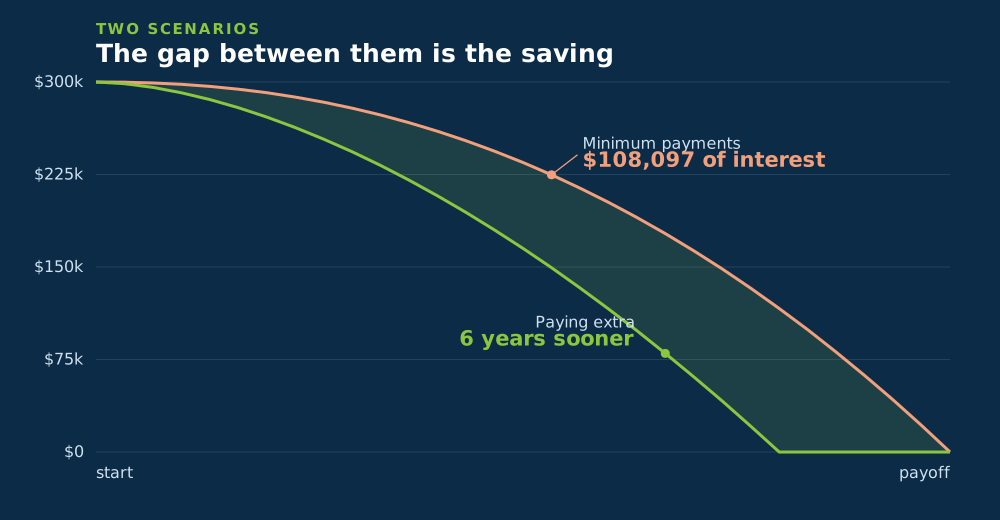
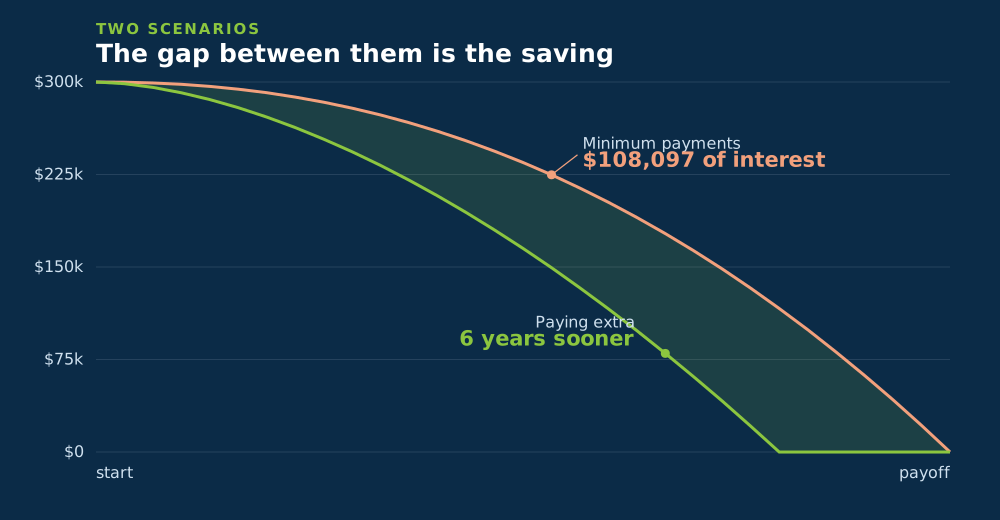
A mortgage or car loan is a controlled version of the same mechanism. Interest is charged on the outstanding balance each period, exactly as it compounds on a card — but you make a payment large enough to cover it and reduce the principal, so the balance falls instead of growing.
That is really all an amortizing loan is: compound interest with a payment big enough to beat it. Which is also why an extra payment is so powerful. It removes principal that would otherwise have generated interest for every remaining month — the compounding runs in reverse, in your favour. The amortization schedule shows this happening row by row.
What follows from all this
- Start now rather than optimising. A mediocre plan begun today beats a perfect one begun in five years.
- Rate beats frequency. Chase the rate; ignore compounding-frequency marketing.
- Never pay only the minimum. Fix the payment amount and the maths changes completely.
- Clearing a 24% debt is a guaranteed 24% return. No investment offers that with certainty.
- Expect the curve to feel flat first. Most of the growth arrives in the final third. That is not a sign it is failing.