
What a score is measuring
A credit score is a prediction, not a judgement. It estimates the probability you will fall 90 days behind on a payment in the next two years. Everything in the formula exists because it correlates with that outcome.
FICO, the model most lenders use, weights five categories:
- Payment history, about 35%. Whether you pay on time. The single largest factor.
- Amounts owed, about 30%. Chiefly credit utilisation — balances as a percentage of limits.
- Length of credit history, about 15%. Average and oldest account age.
- Credit mix, about 10%. Revolving and instalment accounts.
- New credit, about 10%. Recent enquiries and newly opened accounts.
Note what is absent: income, savings, employment, age, and where you live. Lenders consider those separately, but they are not in the score.
What each band costs
Lenders price in tiers. Crossing a threshold moves you to a different sheet, which is why a twelve-point improvement can matter enormously or not at all depending on where you start.
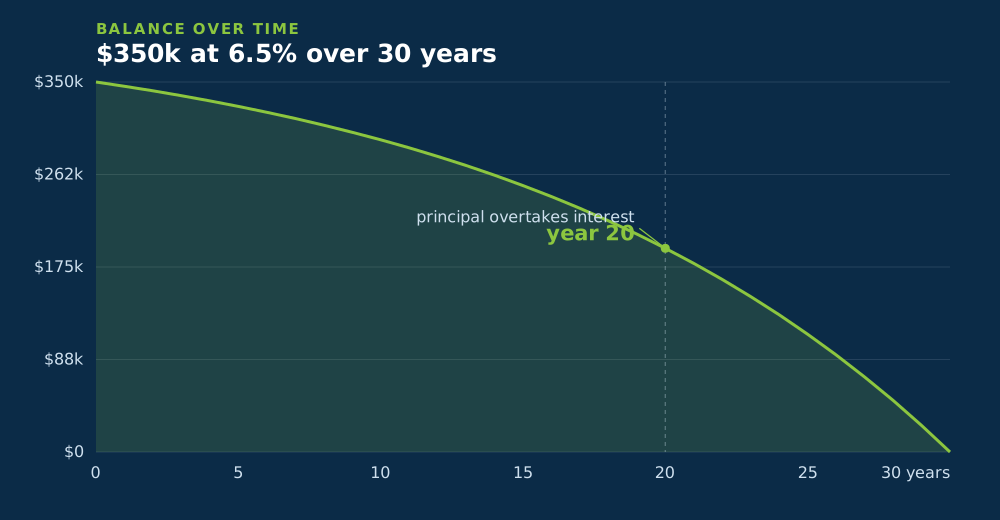
Using illustrative pricing on a $350,000 30-year mortgage, the pattern looks like this:
- 760+ — best available pricing.
- 700–759 — roughly a quarter point higher, around $55 more a month.
- 660–699 — roughly three quarters of a point higher, around $170 more a month.
- 620–659 — well over a point higher, and often extra fee adjustments on top.
- Below 620 — conventional financing becomes difficult; FHA or non-QM, both more expensive.
At the extremes the difference exceeds $400 a month, which across thirty years is more than $150,000. Run your own comparison in the mortgage calculator by entering two rates and reading the total interest line.
The effect is proportionally larger on unsecured credit. A personal loan might run 8% at 760 and 24% at 620 — three times the cost of the money.
What moves a score quickly
Paying down revolving balances
The fastest legitimate lever there is. Utilisation is recalculated whenever your issuer reports, usually monthly, and it carries no memory — reducing a balance improves the score in the next cycle.
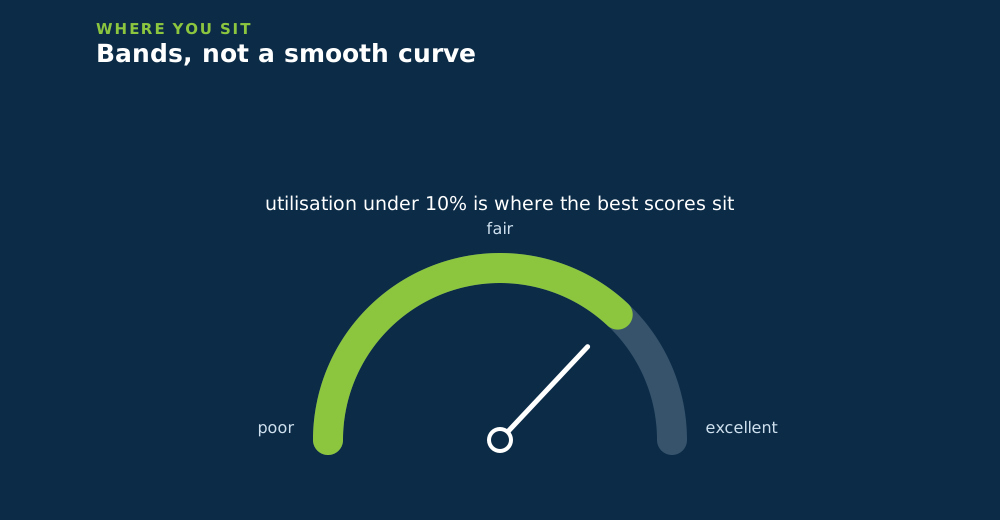
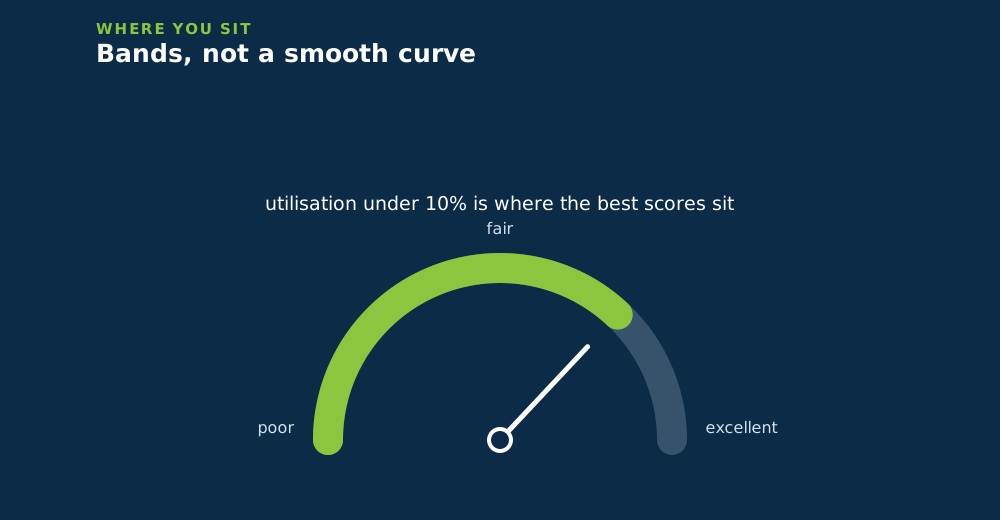
Below 30% is the common guidance; below 10% is where the best scores sit. Both overall utilisation and per-card utilisation matter, so one maxed card among several empty ones still hurts.
Asking for a limit increase
Utilisation is balance ÷ limit. Raising the denominator works as well as lowering the numerator, and many issuers grant increases with a soft enquiry. Only useful if you will not spend into it.
Paying before the statement date
Issuers report the statement balance, not the balance after you pay. Paying a few days before the statement closes reports a lower figure, even if you always clear in full.
Disputing genuine errors
Errors are common — accounts that are not yours, balances already settled, dates wrong. You are entitled to a free report from each bureau, and bureaus must investigate disputes within 30 days.
What only time fixes
- Late payments. Stay on the report for seven years, though their weight fades. A single 30-day late can cost 60–110 points on a high score.
- Account age. Cannot be accelerated. Which is why closing an old card you no longer use is usually a mistake.
- Collections, charge-offs, bankruptcy. Seven years for most, ten for a Chapter 7 bankruptcy.
- Hard enquiries. Two years on the report, twelve months of scoring impact, a few points each.
Rate shopping without damage
Scoring models treat multiple enquiries for the same product as one event within a window — typically 14 to 45 days depending on the model. Mortgage, auto and student loan enquiries are all covered.
Practical version: compress all applications for one loan type into a two-week window. Do not mix product types in it, because a mortgage enquiry and a credit card enquiry will not be merged.
A realistic plan before applying
Six months out
Pull all three reports. Dispute errors. Stop opening new accounts. Do not close old ones.
Three months out
Drive utilisation down hard, aiming under 10%. Request limit increases where they are soft-pull.
One month out
Pay balances before statement dates. Make no large purchases on credit. Do not co-sign anything.
During underwriting
Change nothing. Lenders commonly re-pull credit shortly before closing, and a new account or a rising balance can reprice or sink the loan.